NJALSMERKE
Credit:
The average horse enthusiast might describe Fjord horses as creamy brown with an upright, bi-coloured mane. However, Fjord horses are, in fact, all dun-coloured, with five main colour variations recognised in the breed standard. These variations, are Red Dun (Rødblakk), Yellow Dun (Gulblakk), Grey (Grå), Brown Dun (Brunblakk), and White Dun (Ulsblakk).
Each primary colour manifests in a multitude of shades, yet share common traits. These include a full-length dorsal stripe extending from the forelock to the tail’s tip, cross markings on the legs, and coloured tips on the ears. Some individuals may also exhibit cross markings across the withers and “Njålsmerke“, a dark spot most commonly found on the cheek.
Fjord horses should not have white markings, although the current standards do allow a small white star on mares and geldings.
The feet of a Fjord Horse shall be black except in the red or yellow dun where lighter colours may occur as part of that colour’s individual characteristics.
BROWN DUN (BRUNBLAKK)
The most common colour among Fjord Horses, accounting for 85-90% of the population, is Brown Dun. The body colour ranges from light pale to rich caramel, featuring a black or very dark brown dorsal stripe extending through the mane and tail.
Genetically, Brown Dun horses may have one of the following genotypes: AA EE DD CC, AA Ee DD CC, Aa EE DD CC, or Aa Ee DD CC.
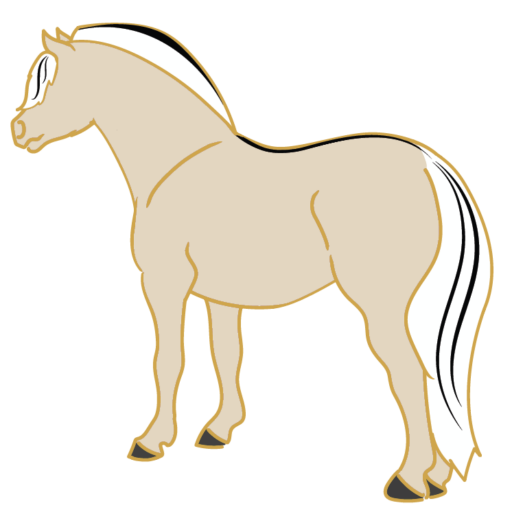
BRUNBLAKK
RED DUN (RØDBLAKK)
Comprising 4 to 5% of the population, Red Dun can be difficult to distinguish from Brown Dun based on body colour alone. However, a dorsal mane stripe devoid of black hairs, ranging from nearly invisible to rich chestnut, identifies a Red Dun.
This colour’s genetic possibilities include AA ee CC DD, Aa ee CC DD, or aa ee CC DD.
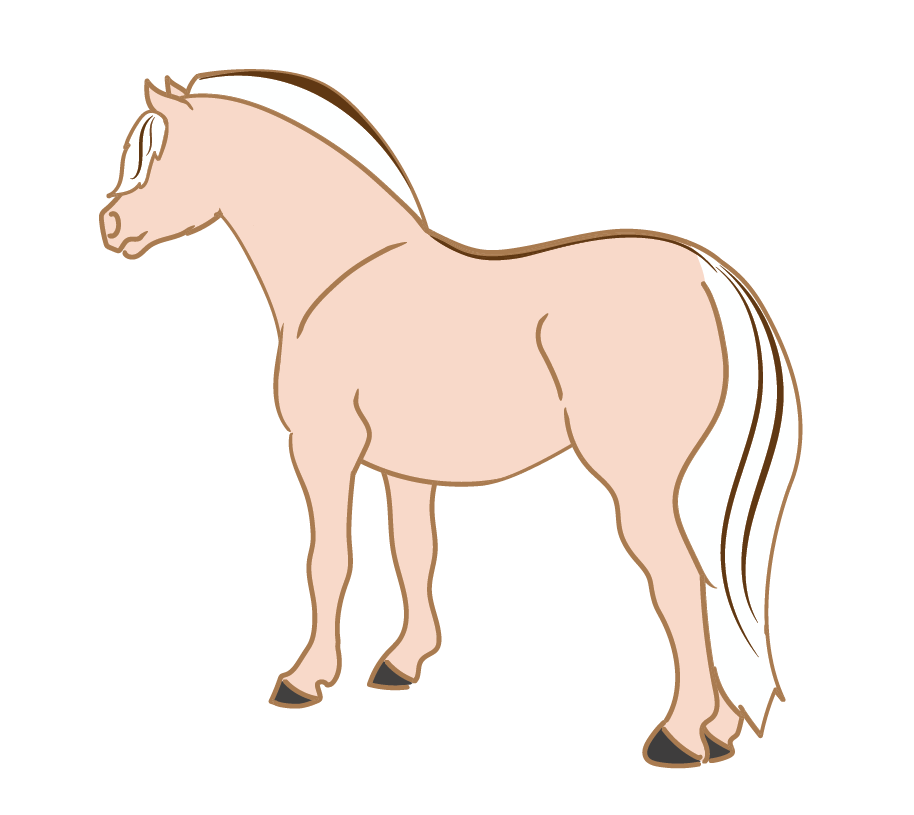
RØDBLAKK
WHITE DUN (ULSBLAKK)
Representing about 4% of the population, White Dun horses have a coat colour ranging from pale yellow to true white, with a dorsal stripe in black or greyish black. This colour results from a dilution of Brown Dun by the Cryptic gene, with possible genotypes being AA EE DD Cc(cr), AA Ee DD Cc(cr), Aa EE DD Cc(cr), or Aa Ee DD Cc(cr).
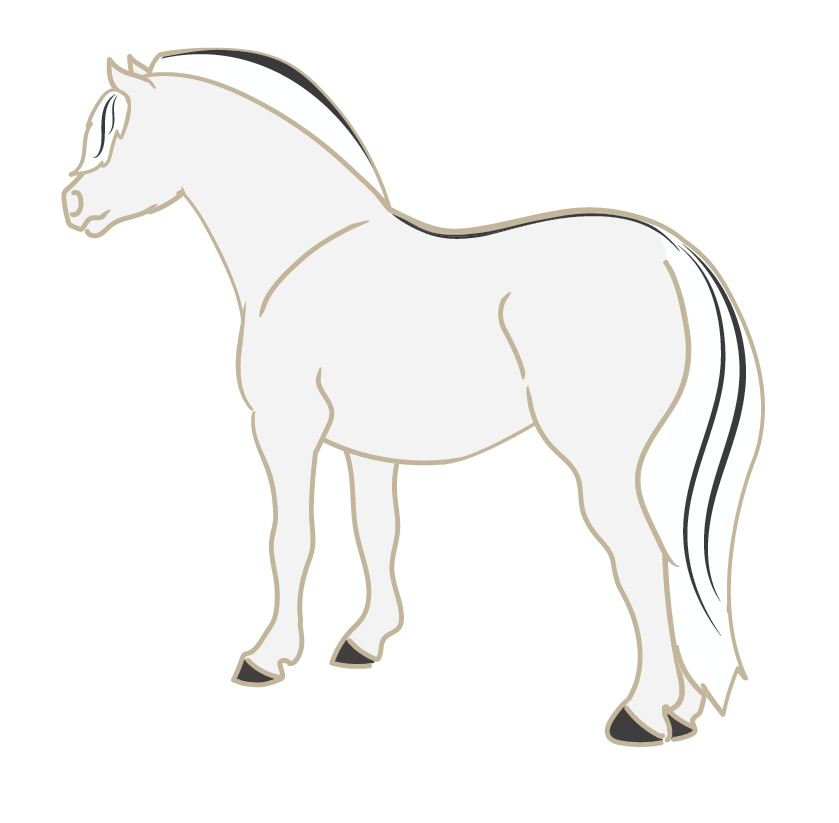
ULSBLAKK
GREY DUN (GRÅ)
Approximately 4% of Fjord Horses exhibit a Grey colour, varying from pale to dark slate grey. Unlike general grey horses that lighten with age, this fixed shade results from black pigment dilution, more accurately termed Black Dun. Grey horses have a black dorsal stripe and darker facial features compared to their body.
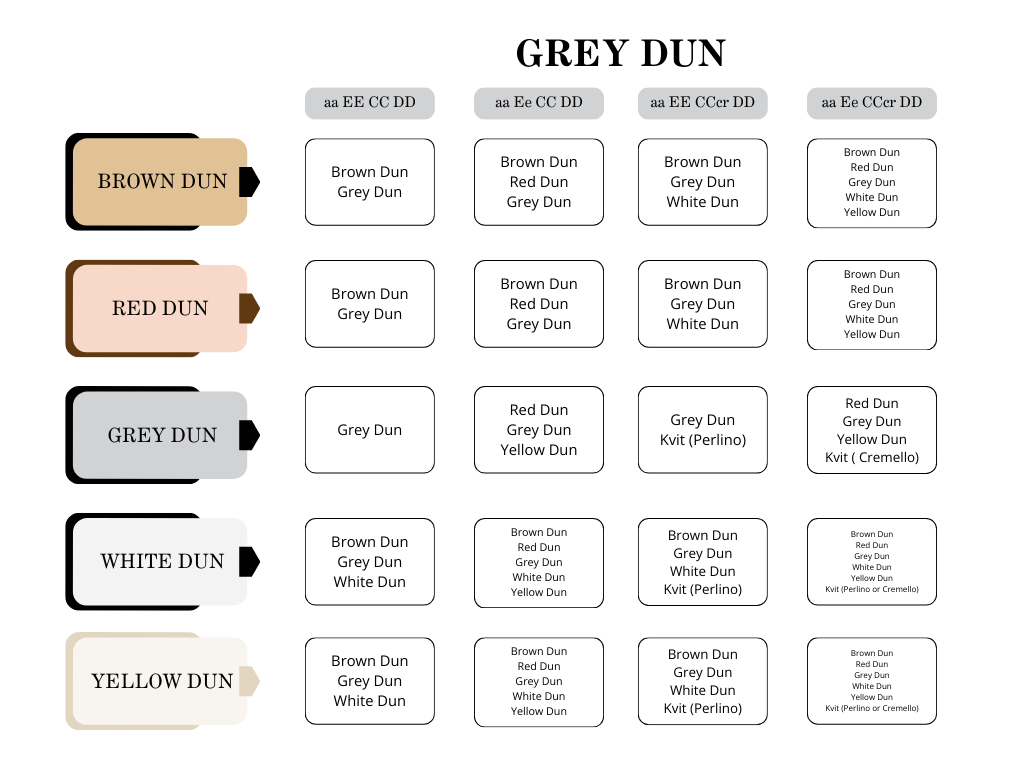
Their genotypes can be aa EE CC DD, aa Ee CC DD, aa EE Cc(cr) DD, or aa Ee Cc(cr) DD.
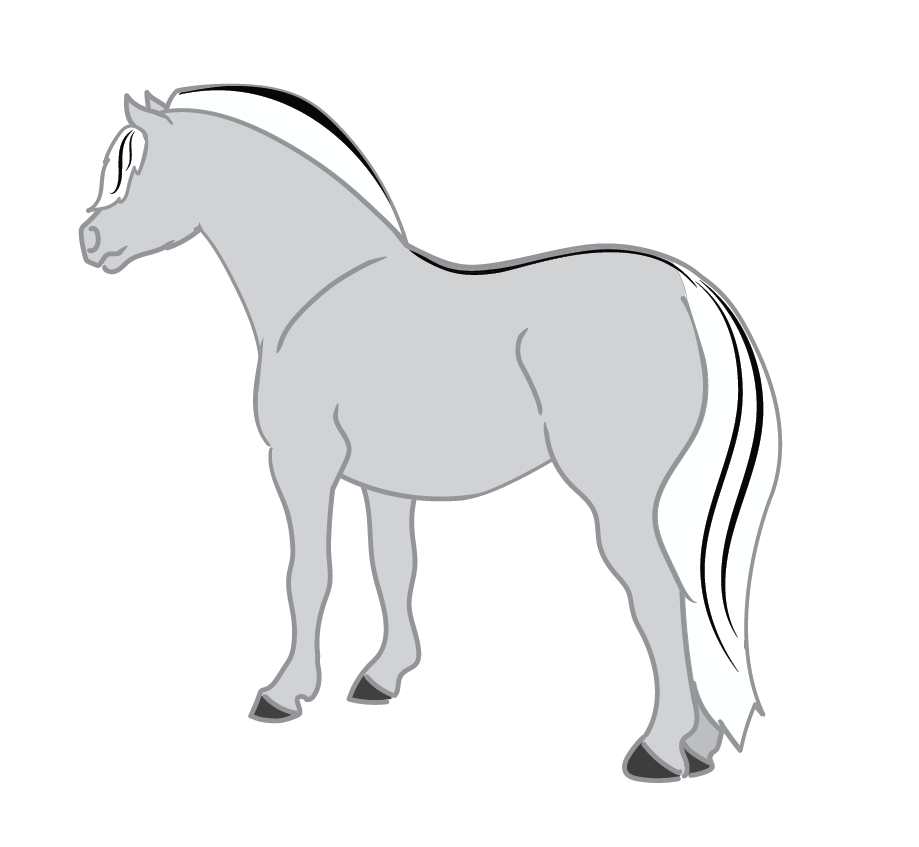
GRÅ
YELLOW DUN (GULBLAKK)
The rarest colour, Yellow Dun, appears in only about 0.5% of the global population, featuring a pale yellow or creamy white body with a golden hue.
This dilution of Red Dun by the Cryptic gene yields genotypes of AA ee Cc(cr) DD, Aa ee Cc(cr) DD, or aa ee Cc(cr) DD.
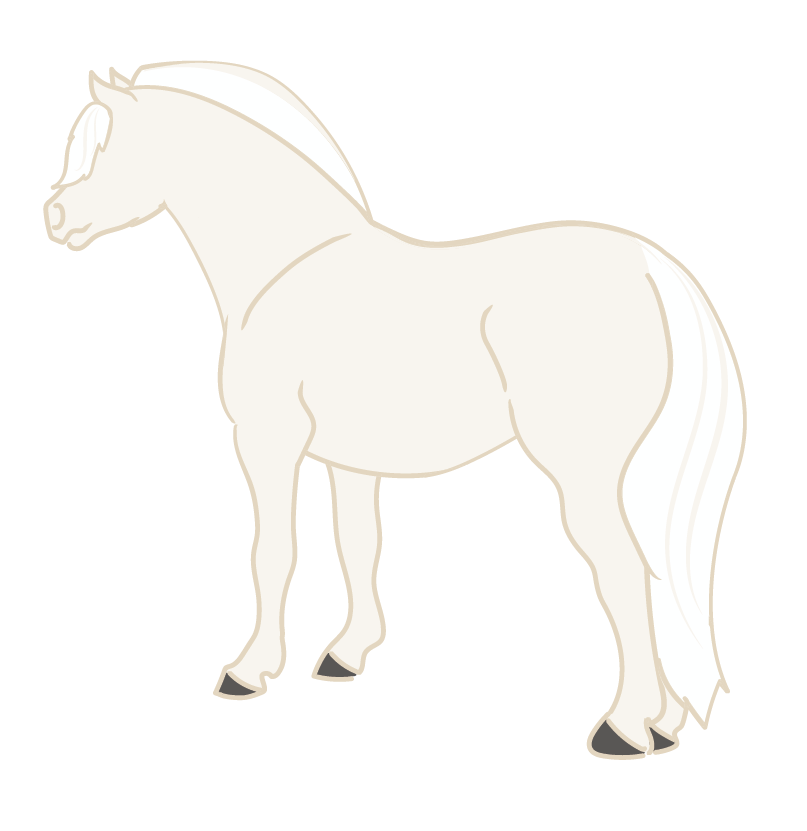
GULBLAKK
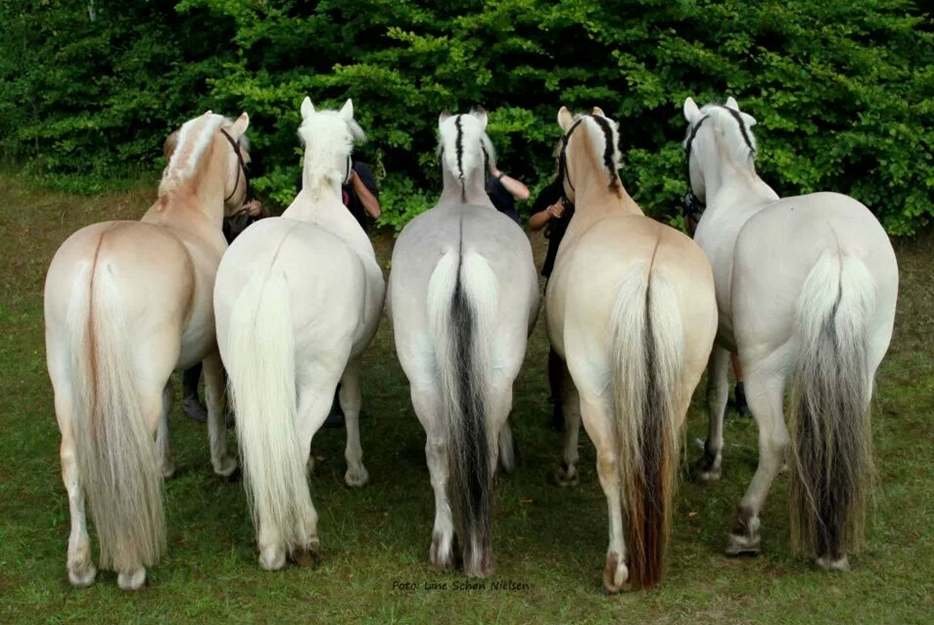
LEFT TO RIGHT: Red dun (Rødblakk), Yellow dun (Gulblakk), Grey (Grå), Brown dun (Brunblakk) and White Dun (Ulsblakk)
Picture Credit: Line Schøn Nielsen (Used with permission)
KVIT
Occasionally, individuals with two recessive c(cr) alleles, known as Kvit, emerge, typically from breeding two White or Yellow Duns or one of each. Though a Grey parent may also carry c(cr), matings producing Kvit offspring are rare due to breed standard preferences. Kvit horses exhibit a Cremello or Perlino phenotype with blue eyes. Kvit colouring is not permitted by the breed standard.
Why is Kvit not accepted?
Selective breeding practices within the Norwegian Fjord Horse community have long prioritised the preservation of the breed’s traditional characteristics. The exclusion of Kvit from the accepted colour palette is a reflection of these selective breeding practices aimed at maintaining the breed’s genetic integrity. Breeders are encouraged to select against traits that are not recognized within the breed standard to ensure that the genetic pool remains consistent with the breed’s established characteristics.
While Kvit horses may possess their own unique beauty, the colour is not accepted within the Norwegian Fjord Horse breed due to considerations of genetic purity, breed standard uniformity, historical significance, and selective breeding practices. Maintaining the traditional dun colour spectrum is seen as essential to preserving the breed’s identity and heritage.
DETERMINING COLOUR FROM BIRTH
Determining the colour of a foal can often be challenging until the foal coat has been shed. However, paying close attention to their primitive markings, especially the dorsal stripe in the mane, can provide significant clues. If the genetics of the parents are known, predicting the offspring’s colour can be done with a reasonable degree of certainty. Nowadays, the most reliable method for determining a foal’s colour is through DNA testing.
Before DNA testing became available, analysing the foal’s ancestry offered insights into possible coat colours. In simple terms, if the pedigree shows exclusively Brown Dun ancestors, it is highly unlikely for the foal to exhibit any colour other than Brown Dun.
BASIC GENETICS
When examining horse coat colours, we focus on specific gene locations (loci) and their impact on coloration. In Fjord horses, four primary loci are of interest: Eumelanin (E), Agouti (A), Dun (D), and Cryptic (C).
Eumelanin determines black pigmentation. Horses with a homozygous EE or heterozygous Ee genotype display a black phenotype unless influenced by other genetic factors, while homozygous ee results in red colouring due to the absence of black pigment.
The Agouti locus influences the distribution of black pigment to the mane, tail, and legs, resulting in a bay phenotype (reddish-brown body) for genotypes AA or Aa; aa genotype horses are black.
The Dun gene, dominant in all Fjord horses, dilutes the base coat colours to dun shades, typically seen as homozygous DD, although Dd is also possible.
The Cryptic locus involves pigment creation; the c(cr) allele causes varying degrees of pigment dilution. A CC genotype retains the horse’s base color, Cc(cr) results in diluted red pigment to yellow or white, and c(cr)c(cr) leads to complete pigment dilution, yielding pale skin and blue eyes.
The following pictures may assist in determining the likelihood of any particular colour from the colour of their parents :